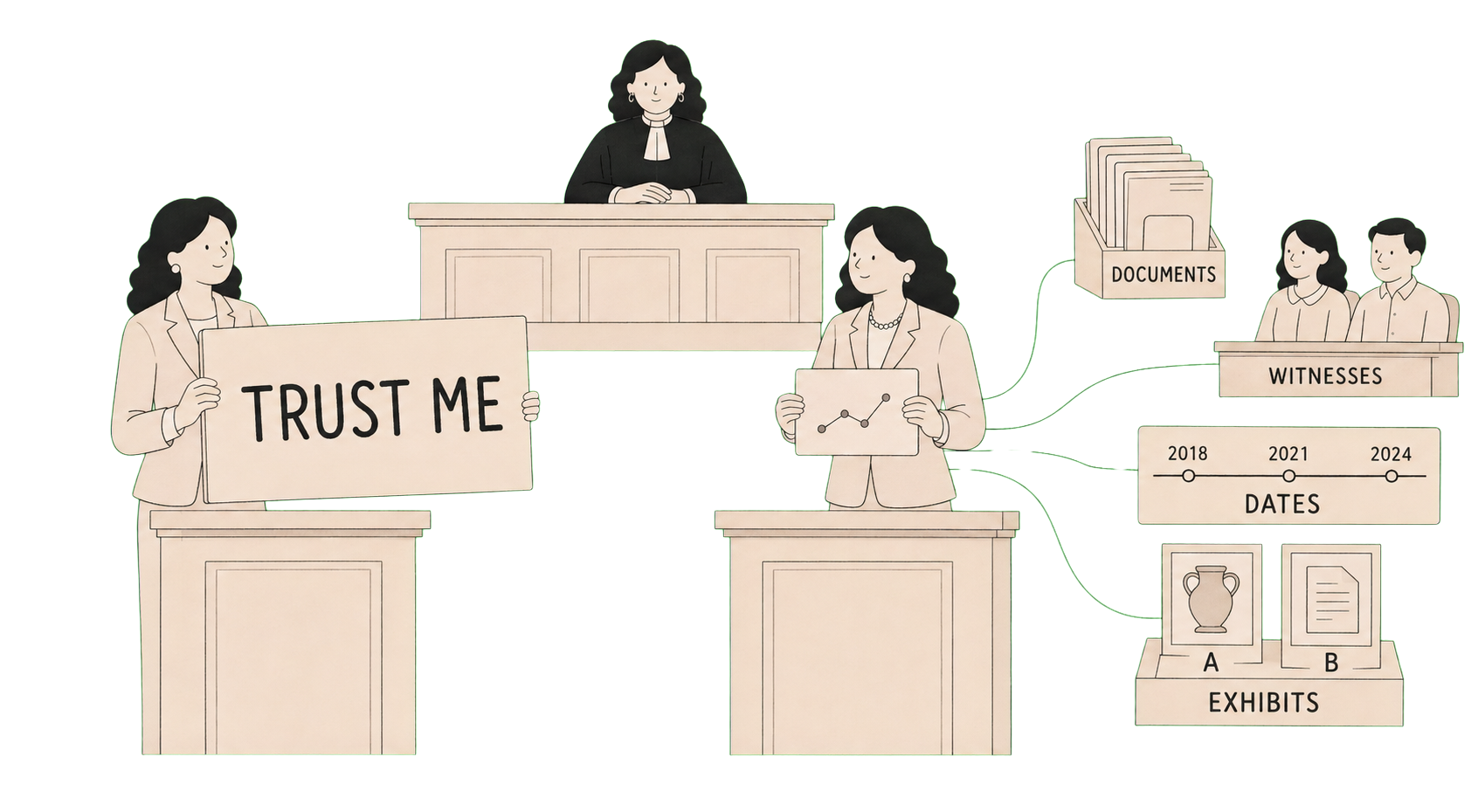
The evidence your brand needs before it makes a claim
There is a sentence doing a lot of unpaid labor on service-business websites everywhere:
“We deliver transformational results through our proven, one-of-a-kind approach.”
Fantastic.
What results? Proven how? One of a kind compared with what?
The sentence sounds authoritative. It may even be true. But the reader has been asked to take the entire thing on faith.
A strong brand is not the one that makes the largest claim in the biggest font.
It is the one that knows what it can say, why it can say it, and what another person would need to see before believing it.
Confidence makes the claim. Evidence makes the case.
When I was an investigative journalist, I could not walk into my editor’s office and say, “A guy told me the mayor is corrupt. He seemed extremely sure.”
I would have been sent directly back to my desk.
The confidence of the source did not make the claim publishable. I needed documents, dates, witnesses, public records, context, corroboration, and a clear understanding of what the material could actually prove.
Your brand is not a criminal investigation, thankfully.
But the principle is useful.
If the website says your approach is different, let people see the difference. If you say clients trust your judgment, show where that trust appears. If you promise a meaningful result, explain what result the work can honestly support.
You do not need to turn your website into a legal brief. You do need enough support for a reasonable person to reach the conclusion with you.

Evidence does more than prove you are telling the truth
Proof has another job that is easy to miss.
It teaches people what to value.
If an interior designer shows only beautiful finished rooms, a prospective client may assume the value is beauty. If she also explains the judgment behind the layout, how the design solved the family’s real routines, and the decisions that prevented expensive mistakes, the client sees a different level of work.
If a therapist shares only that clients “felt supported,” the practice sounds kind. If she shows how the team’s specific approach helped a client understand a long-standing pattern or stay in treatment after previous experiences failed, the reader begins to understand the difference in care.
The proof you choose directs attention.
It tells the market which part of your work matters.
Your strongest proof may not be a percentage
When founders hear the word evidence, many immediately assume they need a 47-percent increase displayed inside a tasteful circle.
Numbers are useful when you have them and can connect them honestly to the work. They are not the only kind of proof.
An established business usually has evidence hiding in several places.
Observable results
This may be revenue, inquiries, conversion, patient growth, time saved, locations opened, stronger hiring, a larger opportunity, or a specific behavior that changed.
The wording should match what you can support. “After the launch” is not automatically the same as “because of the launch.” Accuracy is not timid. It is credible.
Repeated patterns
One client story is an example. The same pattern appearing across many clients can reveal expertise.
Maybe founders repeatedly arrive asking for a prettier website when the real issue is that the business has never decided what it should be known for. Maybe patients consistently choose a practice for a reason the practice barely mentions. Maybe clients hire an interior designer for taste and later describe her judgment as the thing that saved them the most money.
A pattern shows that your perspective came from contact with the work, not from a carousel you saved last week.
Specific testimony
“Amazing to work with” is generous. It is not carrying much strategic weight.
A useful testimonial shows what changed, what the client valued, or what the experience allowed her to do.
One of my clients said:
“I had an idea of what I wanted but had no clue where to start or even verbalize it. This team got to know me as a person first, then did a deep dive on my brand.”
That quote supports a specific promise: you do not need to arrive with the brand figured out. My job is to investigate the scribble with you and find the direction inside it.
The decisions people trust you to make
Sometimes the strongest evidence is the responsibility clients hand you.
What do they stop second-guessing once you enter the room? Which decisions are you invited to shape? Where has your role grown because your judgment proved valuable?
This shows the difference between being hired for your hands and being trusted for your head.
Relevant experience
Credentials and previous roles matter when they help explain why your perspective is credible.
My journalism background matters because it trained me to ask past the first answer, find the missing context, test what could be supported, and decide what a reader needed to understand first. It is not a fun fact pasted into my biography. It explains how I work now.
The useful question is not, “What impressive things can we list?”
It is, “Which parts of our experience make this particular idea more believable?”
The work itself
Sometimes the clearest proof is letting people see how you think.
Show the decision behind the design. Explain why the message changed. Walk through how you diagnosed the problem. Compare the scattered business before the Brand Plan with the clear direction after it.
Do not reveal every internal document. Reveal enough of the thinking for someone to recognize the level of judgment behind the result.

This is what CASE actually means
I use CASE inside Liberty Type because it gives us a clear order for turning years of experience into a position the market can understand and believe.
It is not a clever name for “add testimonials.”
CASE stands for:
Confirm the record
We investigate what is actually true. The history, results, client patterns, trusted decisions, experience, point of view, and ambitions of the business.
Articulate the claim
We decide what the business has earned the right to be known for and say it clearly enough for the market to understand.
Substantiate the case
We connect the right evidence to that claim so the position feels credible, specific, and proportionate.
Express it everywhere
We carry the same central meaning into the messaging, visual identity, website, content, search presence, offers, and client experience.
That is CASE.
Raw experience becomes a clear position. The position is supported. Then the entire brand expresses the same conclusion.
Do not make the reader play detective
One of the most common mistakes is collecting every award, testimonial, logo, number, and press mention in one place and assuming the sheer amount will feel convincing.
It usually feels like a very impressive junk drawer.
Proof becomes more useful when the reader can tell what it proves.
If you say you understand multi-provider therapy practices, show the relevant practice work nearby. If you say your process creates clarity, use the testimony about finally being able to verbalize the business. If you say an integrated team creates a more coherent brand, show how the strategy, copy, identity, and website reinforce the same idea.
Put the proof where the doubt appears.
Think of it as a helpful friend entering the conversation at the exact moment someone raises an eyebrow.
Not six minutes later. Not on a separate page. Right there.

Strong proof still needs honest boundaries
Use extraordinary client outcomes when they are true, approved, and presented with context.
Do not turn one exceptional result into the expected outcome for everyone.
If a client booked a major opportunity after launching, tell the precise story. Explain the reputation, offer, audience, work, timing, and launch conditions that also mattered. Give the brand appropriate credit without turning it into a magic trick.
Your people are smart. They know a new website does not automatically deposit $300,000 into every client’s account.
The complete story is usually more persuasive because it sounds like something that happened in the real world.
The goal is not the loudest claim
The goal is the strongest conclusion your experience can carry.
That conclusion may be more restrained than the line someone could invent in ten minutes. It will also be far more valuable because you can keep saying it, support it in public, and build the brand around it without bracing for someone to ask, “Based on what?”
This is the one place in this six-part series where I want to stay with evidence because evidence deserves its own job. It should support the idea, not become the subject of everything you say.
Inside my free live masterclass, From respected expert to recognized authority, I show how earned expertise becomes something the market can understand, trust, remember, and choose.
The Brand Evidence Behind a Credible Claim
filed under: