

Why more visibility doesn’t fix an unclear brand
When a business is not getting enough attention, the advice arrives fast.
Post more. Start a podcast. Hire a publicist. Run ads. Pitch yourself to bigger shows. Get serious about LinkedIn. Make more Reels. Become the face of the brand.
So you do.
More people see you, but they still do not seem to understand why you are different. The content performs occasionally, but the attention does not build toward anything. People compliment the post instead of inquiring about the work. Your name reaches more people, but it does not seem to mean more.
The problem is not always visibility.
Sometimes the business is visible enough to reveal that the brand is unclear.
A bigger blurry image is still blurry
Imagine putting a photograph into a projector. The image is out of focus, so you make it larger.
Now the confusion is 12 feet wide.
That is what happens when a business invests in more reach before deciding what people should understand.
The ad, interview, speaking opportunity, viral post, or PR feature expands the number of people encountering the image. It does not bring the image into focus.
Visibility increases exposure.
Clarity determines what the exposure means.
This is why a burst of attention can produce surprisingly little movement. People saw the business. They just did not leave with a useful conclusion about it.

Recognition needs something specific to recognize
You cannot become known for “all the things we are very good at.”
People need an association. A subject, problem, possibility, perspective, or idea they know to connect to your name.
That is why someone with less experience can become better known than someone with a much deeper body of work. The less-experienced person may simply be easier to place.
You know what she talks about. You know what she believes. You know when to think of her. You can explain her to someone else without opening her About page and reading the biography aloud.
Meanwhile, the more experienced person may be discussing leadership on Monday, AI on Tuesday, sales on Wednesday, nervous-system regulation on Thursday, and a new offer she felt called to create by Friday.
Every individual post may be smart.
Collectively, the market has no idea which shelf to put her on.
Visibility can put the work in front of more people. It cannot choose the shelf.
The algorithm is very good at choosing what performs
It is less qualified to decide what your career should mean.
Founders sometimes use content to think in public. That can be useful. It can also become a very long way to avoid making a decision.
The AI post gets attention, so you make more AI content. Then a leadership post performs, so the brand swings back toward leadership. A personal story takes off, so vulnerability appears to be the strategy now.
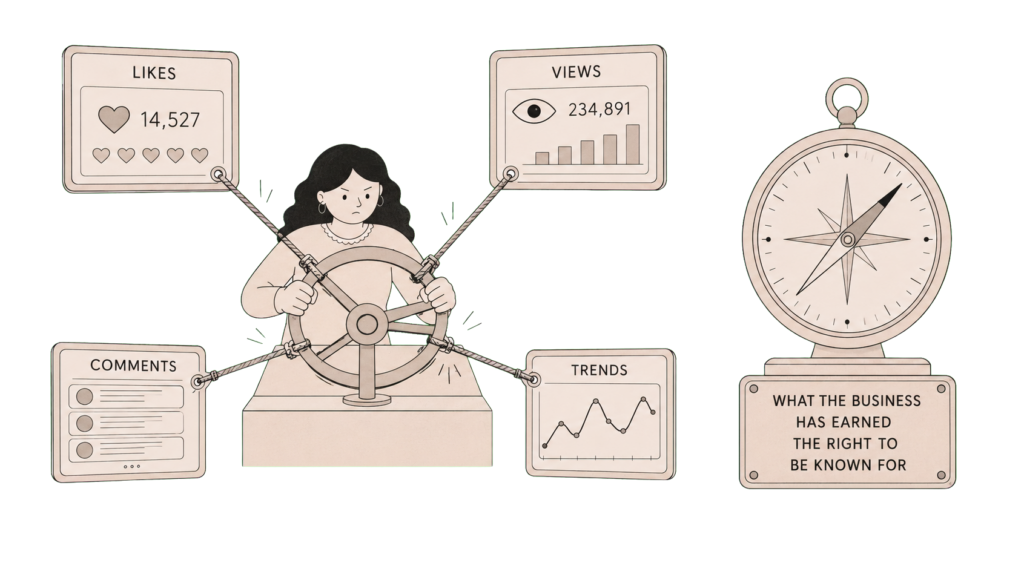
Soon the analytics dashboard is driving the car.
Performance data can tell you what received a reaction. It cannot decide what the business has earned the right to be known for, which idea your best clients value, what supports the offer you want to sell, or what can hold the next five years.
Those are editorial and strategic decisions.
The algorithm can help distribute the work after you make them.
Visibility is an amplifier, not an editor
This is the principle I want you to remember.
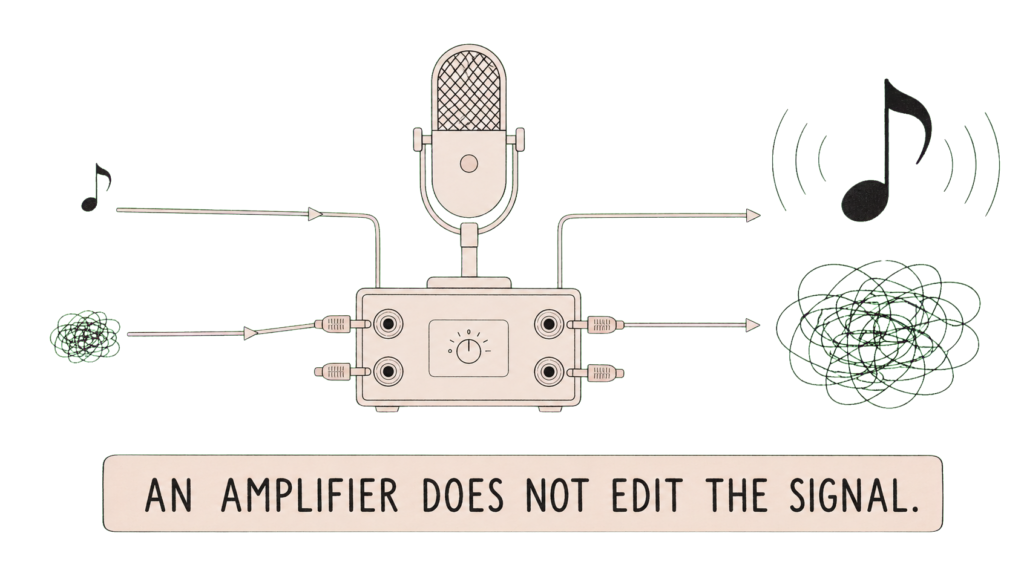
An amplifier makes the existing signal louder.
If the input is a clear musical note, the sound becomes fuller and easier to hear.
If the input is a tangled mess, the tangled mess gets a microphone.
Visibility can amplify a clear position, recognizable point of view, useful offer, and coherent brand.
It can also amplify generic messaging, conflicting offers, a confusing website, and a business no one knows how to describe.
A microphone cannot decide what you mean. It can only make the current message louder.
That is why “get your name out there” is incomplete advice.
Your name needs to become connected to something. Otherwise, people may recognize the face and still have no idea when to call, refer, quote, or choose you.
More channels can produce more versions of the business
An unclear brand rarely stays consistently unclear.
It becomes differently unclear everywhere.
The podcast bio describes one version. Instagram describes another. The website leads with a third. The PR team pitches the most newsworthy angle. SEO follows the phrase with search volume. The designer emphasizes the service with the strongest visual potential. The founder keeps sending clarifying voice notes because every version is partially right and somehow still not it.
It is like a film set without a director.
The costume department thinks it is making a period drama. The lighting team is shooting a thriller. The actors are playing a comedy. The sound team has arrived with horror-movie music.
Every person may be excellent at her job.
The final film still makes no sense.
The problem is not execution. No one decided what the movie was.
That is what a clear Brand Plan should do before content, search, PR, design, and the website begin interpreting the business independently.

Established experts are especially vulnerable to this trap
You know the work is good because you have experienced the evidence firsthand.
Clients get results. Referrals arrive. Peers respect you. The business has lasted. When strangers do not respond with the same level of trust, it is logical to assume they simply have not seen enough of you.
Sometimes that is true.
But your clients have context the public does not.
They have watched you make decisions. They know which part of your history matters. They can feel the difference between you and the nearest alternative because they have experienced it up close.
A stranger receives the public version.
If that version does not organize the same meaning, more exposure introduces more people to an incomplete account of the business.
It does not recreate what your clients know.
Clarity does not mean saying one boring thing forever
The fear underneath all this is understandable.
If I decide what I want to be known for, will every piece of content become the same post in a different outfit?
No.
Think about a great magazine. Every story is not identical. There are profiles, reporting, essays, criticism, photography, interviews, and reviews. The variety makes the publication richer because the editorial world is already clear.
Your position should work the same way.
It creates a shared center of gravity. You can tell stories, respond to something happening in the world, share client examples, teach an idea, discuss a personal experience, or explore a different part of the work. People still understand why it belongs to you.
The goal is not one topic forever.
The goal is for the topics to add up.
Decide what the visibility is supposed to do
Before increasing content, ads, PR, speaking, or partnerships, ask:
- What should people connect to my name?
- What should they understand after encountering me once?
- What idea should become more valuable every time I speak?
- Does the offer give them a way to act on that idea?
- Can someone else explain why I am the person to call?
You do not need perfect answers before publishing anything. If we waited for perfection, the internet would contain four websites and one extremely nervous podcast.
You do need enough direction for the attention to accumulate.
I am not against visibility. I want the right people to see your work.
I am against asking visibility to perform a job it cannot do.
First decide what the business should mean. Then give the microphone something worth amplifying.
Inside my free live masterclass, From respected expert to recognized authority, I explain why more content has not necessarily made you better known and what needs to become clear before visibility can work in your favor.
Why Visibility Doesn’t Fix an Unclear Brand
filed under:

